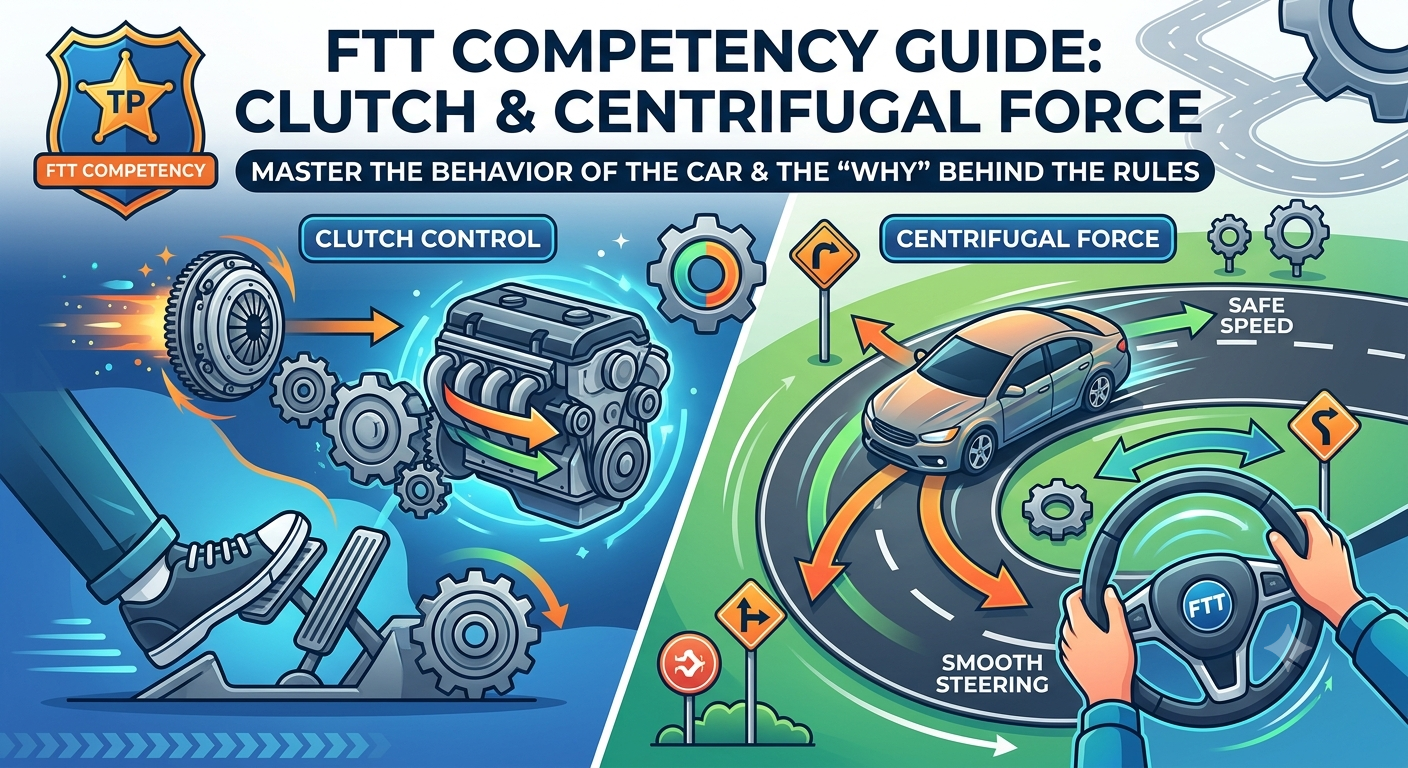
Clutch & Centrifugal Force: FTT Competency Guide
Our FTT Clutch / Centrifugal Force (Competency 1) category is where the FTT starts feeling noticeably different from the BTT. Instead of testing whether you know a rule, it tests whether you understand how a car physically behaves — which means the "why" behind each answer matters more here than almost anywhere else in the question bank.
Why This Category Exists
The Traffic Police design FTT competency questions around the assumption that you've had at least some hands-on time with a vehicle's controls — even if only a lesson or two. If you're studying for the FTT before you've had any practical lessons, this category will feel more abstract than the rest of the test, so it's worth pairing your study here with an early practical lesson if you can arrange the timing.
Understanding Centrifugal Force (Without the Physics Class)
Centrifugal force is the outward pull you feel when a vehicle turns — the sharper the turn or the faster you're going, the stronger that pull. The FTT tests one core response to this:
Slow down before entering a bend, not during it. Braking mid-turn shifts weight in ways that can destabilise the car; the correct technique is to reduce speed on the straight approach, then accelerate gently out of the bend once the steering begins returning to centre.
The tighter the bend, the more speed reduction is needed — this seems obvious, but questions often present a specific bend description and ask you to judge the appropriate response, rather than asking the rule directly.
When to Accelerate Coming Out of a Bend
This is a frequently tested, easy-to-get-wrong detail: you should begin accelerating as the steering wheel is returning to the straight-ahead position — not before, and not after you've already fully straightened out. Accelerating too early while still mid-turn increases the centrifugal effect right when the car is least stable; waiting too long wastes momentum and isn't necessary.
Clutch Control Basics
Several questions in this category test what actually causes a manual car's engine to stall, and the answer is more specific than "using the clutch wrong":
- A sudden release of the clutch (letting it out too fast without matching throttle) is a classic stalling cause.
- This is different from a sudden release of the brake or handbrake, which the FTT tests as a separate (and non-stalling) scenario — don't lump these together.
Smooth, gradual clutch release paired with appropriate accelerator input is the core technique being tested throughout this category.
Gear Selection in Parking Scenarios
Expect at least one question testing correct gear engagement when parked on a slope:
- Parking downhill: engage reverse gear (for manual transmission), so that if the car rolls, the engine compression works against the direction of the roll.
- Parking uphill: engage first gear, for the same reason in the opposite direction.
- On flat ground: neutral is appropriate, generally combined with the handbrake.
These questions test the underlying logic (using engine compression as a safety backup to the handbrake), so understanding why the gear choice matters helps more than memorising "downhill = reverse" as an isolated fact.
Positioning for Bends
A related competency question style asks about vehicle positioning approaching a bend — for example, positioning closer to the outside of your lane on approach to a sharp bend to improve your sightline around the corner, without crossing into the opposing lane. This ties back to the same centrifugal force logic: better visibility lets you judge your speed reduction more accurately before you're committed to the turn.
Why This Category Rewards Understanding Over Memorisation
Because these questions describe a physical scenario and ask what you should do, memorising answer letters from repeated practice without understanding the underlying mechanics tends to fall apart the moment a question is worded differently from one you've seen before. Take the extra time here to understand why each answer is correct, not just which option to select.