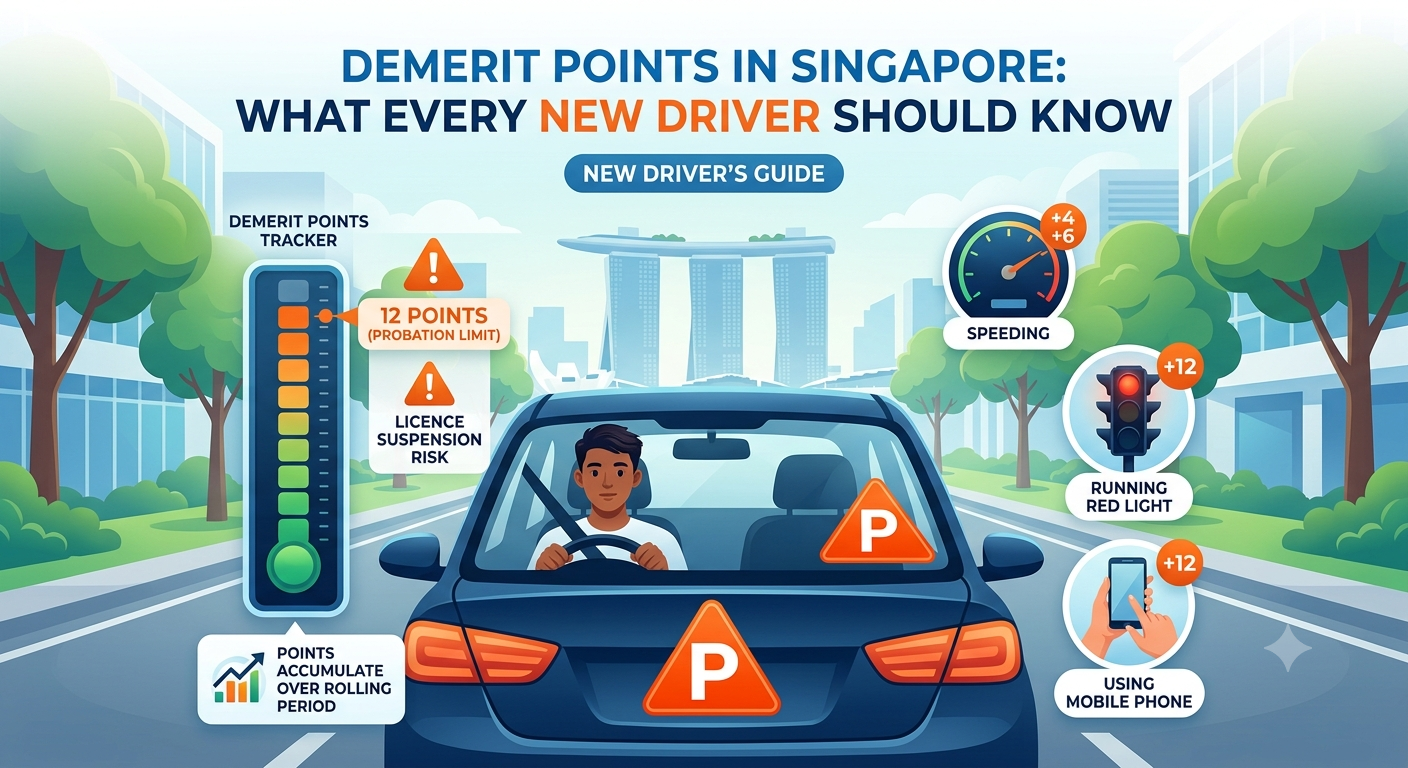
Demerit Points in Singapore: What Every New Driver Should Know
Getting your licence isn't the finish line. Once you're driving on your own, every traffic offence carries a demerit point value, and those points follow you even after you've paid a fine or attended court. Understanding how the system works now, before you ever commit an offence, is one of the simplest ways to protect a licence you worked hard to earn.
What Are Demerit Points?
Demerit points are penalty points added to a driver's record for traffic offences. They exist alongside fines and court penalties as a separate tracking system. The Traffic Police record these points against your licence, and once you cross certain thresholds within a set period, additional consequences kick in beyond whatever fine you already paid.
Who the System Applies To
- Probationary drivers, meaning anyone within 12 months of passing their Practical Driving Test
- Full licence holders who have completed their probation period
- Riders and drivers across all vehicle classes, including motorcycles
The thresholds differ depending on which group you fall into, which is exactly why new drivers need to pay closer attention than most.
Why Probationary Drivers Face Stricter Limits
If you're within your first 12 months of holding a full licence, you're classified as a probationary driver. The demerit point ceiling before your licence gets suspended is lower for this group than for experienced drivers. The reasoning is straightforward: new drivers are statistically more likely to be involved in accidents, so the system is designed to catch risky patterns early rather than waiting for a serious incident.
Common offences that add points quickly for new drivers include speeding, beating a red light, and careless driving. A single serious offence combined with an existing point or two can be enough to push a probationary driver over the limit.
How the Point Thresholds Work
Points accumulate over a rolling period rather than resetting on a fixed calendar date. This means the relevant question is never "how many points do I have this year," but "how many points have I accumulated in the trailing window the authorities look at." Two key outcomes follow once you cross a threshold:
- Reaching the lower threshold for probationary drivers, or the higher threshold for full licence holders, triggers a licence suspension.
- Repeating this within a shorter follow up window leads to a longer suspension, and further repetition can result in disqualification requiring a fresh application process.
Points Don't Disappear With a Paid Fine
This is the detail that catches people off guard most often. Paying a fine settles the financial penalty, but the demerit points tied to that offence remain on your record for the relevant tracking period regardless of payment. Points are only removed once they age out of the window the Traffic Police use, not because the associated fine or court matter has been closed.
Offences That Commonly Carry Demerit Points
- Speeding, with the point value increasing alongside how far over the limit you were
- Running a red light or failing to stop at a stop sign
- Careless or inconsiderate driving
- Using a mobile phone while driving
- Illegal parking in restricted zones, such as along yellow box junctions or ambulance access lanes
- Failing to wear a seatbelt, for the driver or a passenger under their responsibility
The exact point value attached to each offence is set out by the Traffic Police and reviewed periodically, so treat any specific number you see online as a general guide rather than a fixed figure to memorise for the theory tests.
Practical Habits That Keep Your Record Clean
- Build in extra travel time so speed limits don't become negotiable when you're running late.
- Treat amber lights as a signal to slow down rather than accelerate through.
- Keep your phone out of reach while driving, not just silenced on the seat beside you.
- Double check parking signage before leaving your vehicle, especially near hospitals, schools, and bus stops.
Why This Matters While You're Still Studying
Demerit points and the offences behind them show up regularly in the Final Theory Test, since the FTT focuses heavily on the consequences of unsafe driving rather than just mechanical knowledge. Learning the logic behind the system now, rather than memorising isolated numbers, makes those questions far easier to reason through on test day.
The Basic Theory Test SG app separates BTT and FTT practice into their own categories, so once you're ready to move into road safety and consequence based questions, you can focus your revision there directly.
If you haven't already, check out our previous article on the Provisional Driving Licence (PDL), the document you'll need before your demerit point record even starts building up on the road.